
The most common mistakes in the Slovak A2 exam — part by part
7 min read
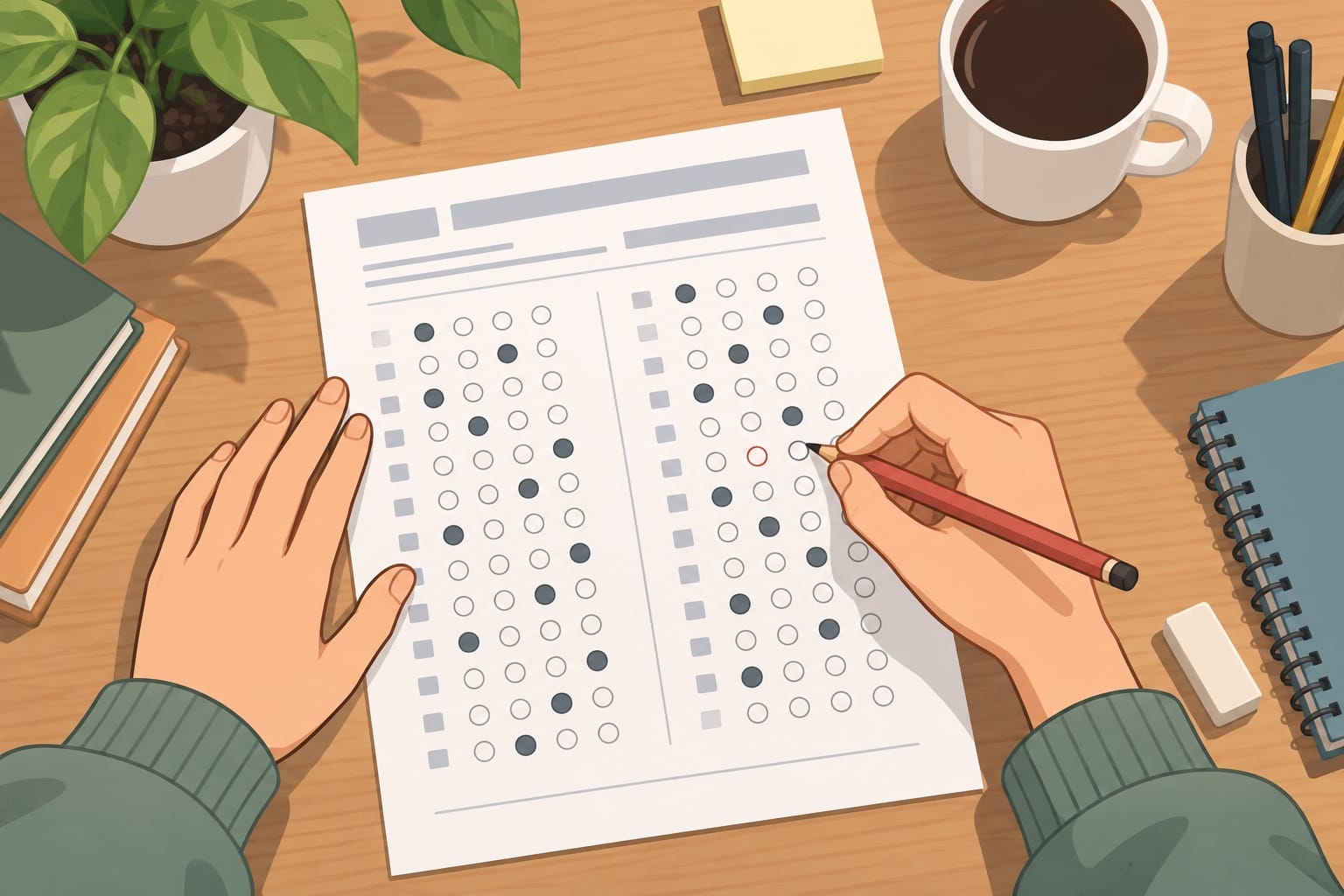
Most of the points lost in this exam are lost not for poor Slovak but for formal reasons — for not reading the instructions to the end, for a blank space, for missing diacritics and for a question from the task left unanswered. That is good news: these are mistakes you can eliminate in a week, while the language itself takes months to build.
They are arranged below by where in the exam they arise. First, though, one mistake that precedes all the others.
Mistake number zero: sitting an exam you do not need
The exam costs roughly 100 to 180 euros and takes a whole day. And it is a condition of a single residence permit — the long-term one, that is the status of a long-term resident of the EU (§ 52(7) and § 54(4) of Act No. 404/2011 Coll., in force from 15 July 2025).
Permanent residence, temporary residence (work, business, study, family reunification) and temporary refuge carry no language condition. Several commercial sites state otherwise and it is not true. On top of that § 52(7) contains exemptions — being under 14 at the time the application is filed, temporary residence of a Slovak living abroad, and education obtained with Slovak as the language of instruction. Before you pay, go through which residence permit the exam is needed for and the overview of exemptions.
Mistakes that apply to the whole exam
- A blank answer. An unanswered item always scores zero; a guess has a non-zero chance. In multiple-choice tasks never leave a blank.
- Not reading the instructions to the end. Sentences of the "you will not need two of the options" kind are information, not decoration.
- Getting stuck on one item. The times are short. Move on and come back.
- Missing diacritics. In the supply tasks they are part of the correct answer; v chladničke yes, v chladnicke no.
- Counting on one national format. There is none — more on that below.
Reading and grammar
According to the model test of Studia Academica Slovaca this module has five tasks and 25 points, with grammar as part of it; there is no separate grammar module.
- Overlooked distractors. In the classified-ads task there are usually two surplus options. Match "whatever is left over" and you wreck the preceding items as well.
- Hunting for keywords instead of sense. That is exactly what the distractors are built on.
- The wrong case in a gap-fill. You are supplying the word into a sentence, not into a list — it has to fit grammatically. Typically this means the genitive after an expression of quantity, the locative after the preposition v, or the instrumental with the verb platiť (to pay).
- Drilling cases in isolation. At home do gap-fills in whole sentences, because that is how it works in the exam.
Listening
Four tasks, 25 points. At the exam the recordings are usually played twice.
- Using both listenings the same way. Give the first to the whole, the second to the items still missing — not the other way round.
- The wrong form in a short answer. Od prvého apríla, dostanete tašku, na prvom poschodí. Numbers may be written in figures or in words; diacritics count.
- Choosing the "correct sentence" instead of the appropriate reply. In the reply task all three options are usually grammatically correct and on topic; they are wrong only as an answer to that particular line.
- Panicking after the first word you miss. The rest of the recording runs on. Leave the item and keep listening.
We cover the full format of both test modules in the article on reading and listening.
Writing
Two tasks, 20 points, 30 minutes — and the largest formal losses in the whole exam.
- A skipped point of the task. The picture description has three prompt questions, the email three sentences marked in italics. Every unanswered point is missing content, even if the rest were flawless.
- A missing past tense. The third prompt question in the picture description is usually phrased so as to require it. Answer in the present and you lose points for content and for grammar alike.
- The wrong register. A friend writes → you use the informal ty. A formal reply to a friend is something the marker spots immediately.
- Missing the word count. 50–60 words is about five to seven sentences, 70–80 words seven to nine. Learn to judge it at home; at the exam there is no time for counting.
- Notes instead of sentences. A bulleted list does not count as continuous text.
- Treating both tasks with equal care. The email is worth 12 of the 20. If time is running out, finish it.
The procedure for both tasks is in our article on writing.
The oral part
- Silence. An unanswered question is zero. Even a simple, or slightly flawed, sentence is more.
- A memorised monologue. It falls apart at the first follow-up question and sounds unnatural.
- Over-long multi-clause sentences. For A2 the guidance speaks of a "series of phrases and sentences for a simple description" — short sentences are the right strategy, not a concession.
- Translating in your head. Assemble the sentence in your own language first and you speak slowly and with errors in word order.
- Too quiet a voice. Intelligibility is assessed too.
- Not using the rescue phrases. „Prepáčte, môžete to zopakovať?" ("Sorry, could you repeat that?") and „Hovorte, prosím, pomalšie." ("Please speak more slowly.") are part of communication at A2, not an admission of failure.
In detail in the oral part and describing a picture.
Mistakes of expectation
These cost no points, but they cost nerves — and sometimes money.
- "The format will be the way I read it on another site." There is no national exam blueprint. The guidance of the Ministry of Education, Research, Development and Youth of 27 October 2025 sets out who may examine, which skills are tested and the pass mark; it does not set the number of tasks, the distribution of points or the timings. Our materials follow the published model test of Studia Academica Slovaca and that too is a model, not a prescription.
- "50 % in each module is enough." No. The threshold is at least 70 % of the total points for the written and oral parts together. Some centres — the state language school in Bratislava, for instance — apply a stricter rule of their own and require 70 % separately from each part; that is their own arrangement, not the wording of the guidance, and it needs checking.
- "I will do the written part and bluff my way through the oral." The oral part is compulsory, and only those who passed the written part proceed to it.
- "The certificate will show me where I struggled." It will not. It contains a single mark — one word from a four-point scale — with no percentages for the individual skills. More in the article on the certificate.
- "The time and the price are the same everywhere." They are not. The written part lasts roughly 60 to 120 minutes depending on the centre, the oral from a few minutes to twice twenty, and the fee is roughly 100 to 180 euros. The exact figures are in the invitation letter from your centre.
How to check yourself
The cheapest way to eliminate formal mistakes is to go through the whole format once as a dry run: sample tests and the second pack, plus exercises with AI feedback that shows you what is missing from your answer — it is a practice aid, not an official exam result. How the exam is marked we cover in the article on marking and procedure; further questions are in our FAQ.
Where to check this
The marking rules are in the Ministry guidance, the statutory basis and the exemptions in Act No. 404/2011 Coll., the grading scale and the fee in Decree No. 321/2008 Coll. and the format of the written modules in the model test of Studia Academica Slovaca. Confirm the exact procedure, timing and fee directly with the language school where you register.
We are not an examination centre or a law firm and we do not administer exams; this is not legal advice. Last verified 26 October 2026.