
Describing a picture in the A2 exam — how to handle it
7 min read
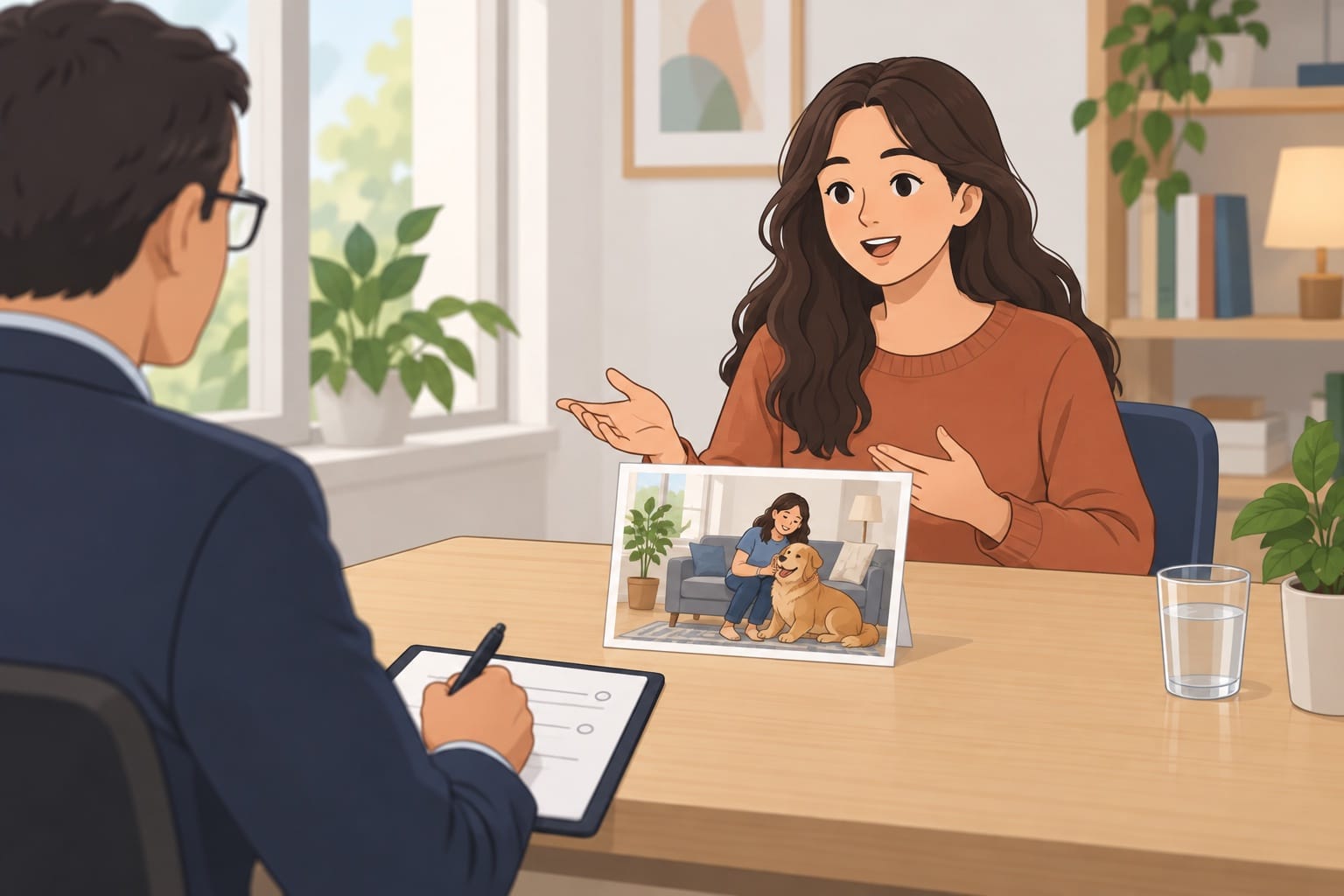
Describing a picture is not one task in the A2 exam but two — you write one and you speak the other. Realise that in advance and you prepare once but score twice. Miss it and you rehearse a single version, only to meet a different format and a different marking route in the other part.
Two different pictures in one exam
The two tasks sit in very different places, and it shows in the result.
| Written description | Oral description | |
|---|---|---|
| Where | Writing module, task 1 | oral part |
| What we know about it | it is in the published model test | the model test does not cover it |
| Length | 50–60 words, continuous text | simple spoken sentences |
| Support | three guiding questions on paper | the examiner's questions |
| Points | 8 of the module's 20 | not published |
| Marking | two independent markers | the examining panel, on the spot |
The difference worth remembering: in writing you steer the description yourself using three questions on paper; in the oral part the examiner steers you. That is why the written description can be learned as an exact procedure, while the spoken one has to bend to whatever you are asked.
What is published and what is not
The written task is documented. Our sample tests follow the published model test of Studia Academica Slovaca (Faculty of Arts, Comenius University in Bratislava), in which the Writing module has two tasks, 20 points and 30 minutes. The first is a picture description guided by prompt questions, 50–60 words long.
The oral description is not documented. The model test does not cover speaking at all. That the oral part consists of a communicative situation and a picture description is something the individual language schools agree on in their own descriptions — the state language school on Palisády in Bratislava, for instance, states that candidates draw two questions, one of them a simple description based on a visual prompt. That is not the text of the Ministry guidance.
There is no national exam blueprint at all: the guidance of the Ministry of Education, Research, Development and Youth of 27 October 2025, issued under § 54(4) of Act No. 404/2011 Coll., sets out who may examine, which skills are tested and the pass mark of 70 % of the total points across both parts together — it does not set the number of tasks, the distribution of points or the timings. Everything below about description technique is therefore our own method, not an official prescription. Nobody guarantees points for it; the only guarantee is that answered questions beat unanswered ones.
A structure that works in both tasks
Do not invent a story. At A2 what is expected is a "series of phrases and sentences for a simple description" — that is the guidance's own wording. It is enough to say what you see, in a fixed order:
- The whole. What it is in general. „Na obrázku vidím rodinu v kuchyni." (In the picture I see a family in a kitchen.)
- People and actions. Who is there and what they are doing. „Vľavo stojí žena a varí. Vpravo sedí muž a číta noviny."
- Place and details. Where it is, what else is there. „V strede je stôl. Na stole je chlieb a čaj."
- You. One sentence about yourself or your attitude. „Aj my doma raňajkujeme spolu. Páči sa mi to."
The fourth point is the cheapest gain in the whole task. For A2 the guidance explicitly mentions describing family, living conditions, education and work — that is, your own experience. A first-person sentence shows you can express it.
Phrases worth knowing by heart
| For | Sentences |
|---|---|
| Opening | „Na obrázku vidím…", „Na fotografii je…", „Obrázok ukazuje…" |
| Position | „vľavo / vpravo / v strede", „hore / dole", „vpredu / vzadu", „za stolom", „vedľa okna" |
| What is happening | „Muž práve číta.", „Žena varí.", „Deti sa hrajú.", „Nikto nehovorí." |
| How many | „Sú tam traja ľudia.", „Vidím dve deti a jedného psa." |
| When | „Je ráno.", „Vonku je tma.", „Myslím, že je zima." |
| Uncertainty | „Myslím si, že…", „Asi je to…", „Nie som si istý/istá, ale…", „Vyzerá to ako…" |
| Attitude | „Páči sa mi to, lebo…", „Mne to pripomína…", „Nie je to pre mňa príjemné." |
„Nie som si istá, ale asi je to nemocnica" ("I'm not sure, but it's probably a hospital") beats silence, and it also beats an invented claim. Uncertainty expressed in Slovak counts as language, not as an error.
What is different in the written task
Here you have three guiding questions printed in front of you, and that is the whole game: an unanswered question is missing content. In the model test, and in our sample tests, the third question is typically phrased so that it requires the past tense — usually asking what you did, or what happened earlier. Answer it in the present and you lose points twice over: for content and for grammar.
Practical rules for 50–60 words:
- Continuous text in full sentences, not notes. Bullet points do not count as text.
- Answer all three questions, each with at least one full sentence. Better short on three than long on one.
- Keep to the length. 50–60 words is about five to seven sentences. Learn to judge that without counting — write a few texts at home and count them until you have the feel.
- Leave a minute for checking diacritics and endings. In written text an error is visible; in speech it slips past.
What is different in the oral task
Here the examiner carries you. Follow-up questions usually come after your description — and that is exactly where it shows whether you can describe, or have merely memorised. So:
- Do not prepare a monologue by heart. It falls apart at the first question and sounds unnatural.
- Speak in short sentences. At A2 that is the right strategy, not a concession.
- Use the rescue phrases. „Prepáčte, môžete to zopakovať?", „Hovorte, prosím, pomalšie.", „Ako sa to povie po slovensky?" They are part of communication at A2, not an admission of failure.
- Speak up. Intelligibility is assessed too.
We cover the whole oral part — including the communicative situation — in a separate article.
Vocabulary by theme
Pictures at this level come from everyday life. It pays to have a few words ready for each common scene:
- Home: kuchyňa, stôl, stolička, chladnička, okno, variť, raňajkovať, upratovať
- Street and transport: zastávka, autobus, električka, chodník, prechod, čakať, nastupovať
- Shop and market: pokladňa, košík, ovocie, zelenina, platiť, vážiť, stáť v rade
- Office and doctor: čakáreň, priehradka, formulár, sestra, objednať sa, vyplniť
- Free time: park, lavička, jazero, kaviareň, prechádzka, oddychovať, stretnúť sa
- School and work: trieda, tabuľa, zošit, kolega, kancelária, učiť sa, pracovať
These are exactly the areas our picture-description exercises cover: Rodinný obed, Na zastávke, V parku, V čakárni, Na trhu, V kaviarni, V škole, Pri jazere, Zimný večer, V supermarkete.
How to practise
Picture description is the one skill you can practise anywhere — a phone full of photographs is all it takes. Ten minutes a day out loud: pick a photo, describe it using the four steps above, record yourself and listen back. Then describe the same photo a second time. The second attempt is noticeably more fluent, and that difference is the whole point of the exercise.
To practise with AI feedback that shows you what is missing from your answer, try picture description and then a spoken answer on a topic. You can work through the written version directly in the sample test — Writing, task 1 and the second pack. The AI assessment is a practice aid, not an official exam result. Further questions are collected in our FAQ.
Where to check this
The list of skills and the 70 % rule are in the Ministry guidance, the statutory basis in Act No. 404/2011 Coll. and the format of the written modules in the model test of Studia Academica Slovaca. Always confirm the exact procedure, timing and fee directly with the language school where you register.
We are not an examination centre or a law firm and we do not administer exams; this is not legal advice. Last verified 21 September 2026.