
The oral part of the Slovak A2 exam — how to prepare for it
7 min readUpdated:
The oral part is the worst-prepared part of this exam — not because it is hard, but because almost nobody writes anything about it. So this article separates three things: what is officially published, what individual centres describe, and what is our reconstruction. Then the practical half: how to build an answer, which sentences to learn, and what to practise out loud.
Let us be straight about what is not published
There is no published model test for the oral part at all. The model test "Testovanie úrovne ovládania slovenského jazyka ako cudzieho jazyka — A2" by Studia Academica Slovaca (Faculty of Arts, Comenius University in Bratislava), which our sample papers follow, covers reading with grammar, listening and writing. Speaking is not in it.
Also unpublished: the internal distribution of points inside the oral part, and any single national duration for it. Across centres we found figures ranging from roughly six to twenty minutes — one number valid for the whole country simply does not exist. Your exact schedule comes with the invitation from the centre where you sit the exam.
Anyone who offers to sell you "the exact format of the oral part" is selling an estimate. We are doing the same thing; we are just calling it by its real name.
What is officially specified
The only national statement about exam content is the list of skills in the guidance of the Ministry of Education, Research, Development and Youth of the Slovak Republic of 27 October 2025, issued under § 54(4) of Act No. 404/2011 Coll. For speaking it says:
"Communication in simple and routine situations requiring a simple and direct exchange of information on familiar topics and activities, using a series of phrases and sentences for a simple description of the family and other people, living conditions, education and work."
That tells you what is expected and what is not. What is expected is a series of simple sentences on familiar topics. What is not expected is fluent narration, argument, or complex subordinate clauses. Two further rules apply: the oral part is compulsory — the guidance prescribes both forms of the exam, written and oral — and only candidates who pass the written part go on to it.
The pass threshold is measured across the total points for both parts together, at least 70 %. Some centres, the state language school in Bratislava among them, apply a stricter house rule and require 70 % in the written part and 70 % in the oral part separately. That is their own arrangement rather than the wording of the guidance, so always confirm the rules with the centre you register at. We cover the marking and the shape of the exam day in a separate article.
What the centres say about the format — and where our reconstruction begins
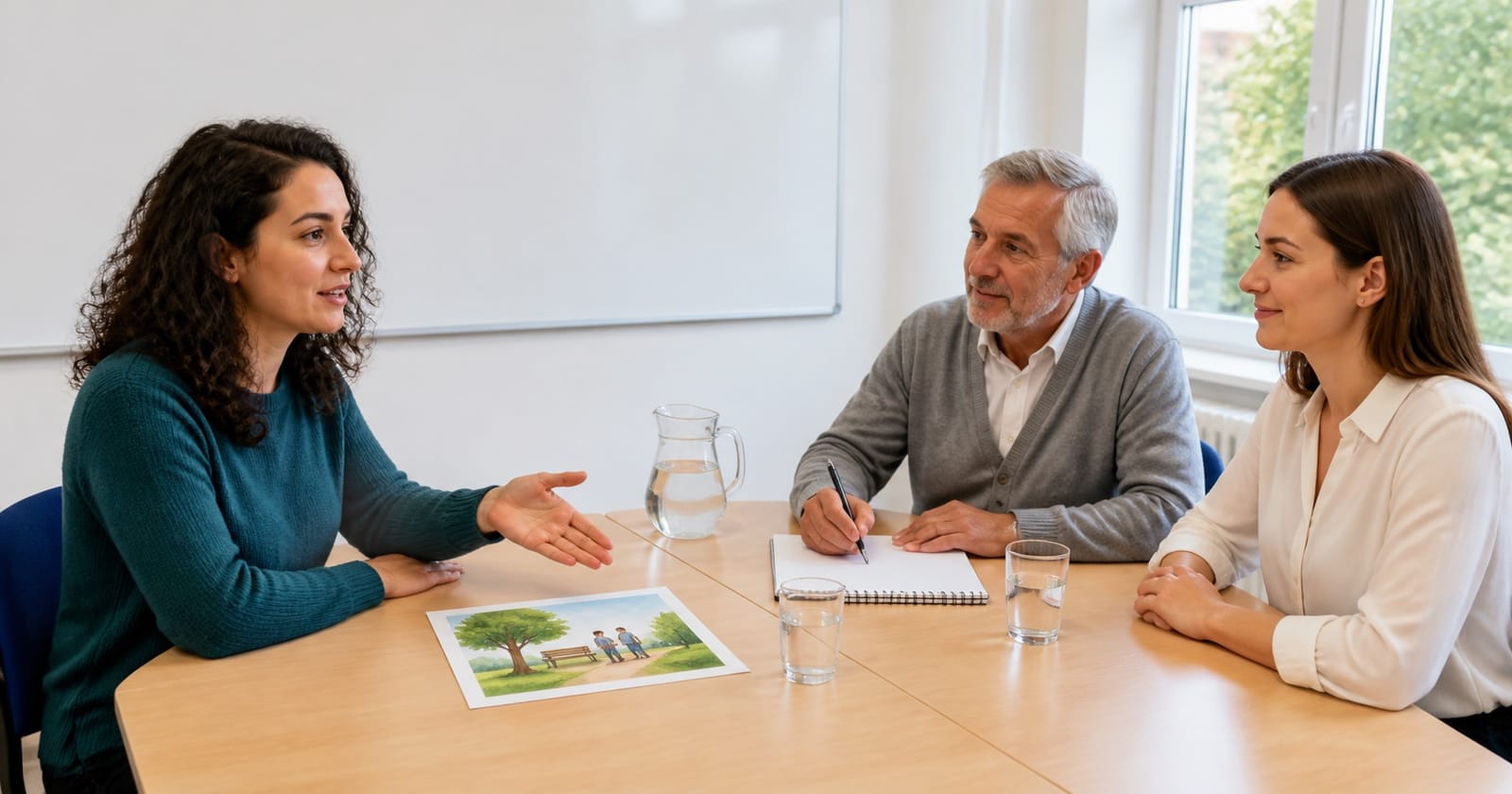
The descriptions published by individual language schools agree on one thing: the oral part has two components — a communicative situation and a picture description. The state language school on Palisády in Bratislava describes it on its own site as the candidate drawing two questions by lot: the first a simple description of a situation from a visual prompt, the second a situational task in which the candidate answers questions in simple, short sentences.
Everything beyond that is our reconstruction, not the official format. Expect to sit opposite examiners, to be given a picture or a described situation and to talk about it; to be led through it by the examiner's questions; and for the oral part to take place the same day, after the written one. Do not plan around any specific number of minutes or points.
How to describe a picture
Do not try to invent a story. At A2 it is enough to say what you see, in a fixed order. This sequence of four works:
- What it is overall. „Na obrázku vidím rodinu v kuchyni." — In the picture I see a family in a kitchen.
- Who is there and what they are doing. „Vľavo stojí žena a varí. Vpravo sedí muž a číta noviny."
- Where it happens and what it looks like. „V strede je stôl. Na stole je chlieb a čaj. V miestnosti je svetlo."
- One sentence about yourself. „Aj my doma raňajkujeme spolu. Mne sa to páči."
That fourth step is the cheapest point you will ever earn: the examiner hears you use the first person and express an attitude, which is exactly what the guidance names when it speaks of describing family and living conditions.
Phrases worth knowing by heart:
| Purpose | Slovak |
|---|---|
| Opening | „Na obrázku vidím…", „Na fotografii je…" |
| Position | „vľavo / vpravo / v strede", „hore / dole", „vpredu / vzadu" |
| What is happening | „Muž práve…", „Žena…", „Deti sa hrajú." |
| Uncertainty | „Myslím si, že…", „Asi je to…", „Nie som si istý/istá, ale…" |
| Your own view | „Páči sa mi to, lebo…", „Mne to pripomína…" |
"I am not sure, but it is probably a hospital" — said in Slovak — beats silence every time. Uncertainty expressed in Slovak is heard by the marker as language, not as an error.
How to handle the communicative situation
The situational task is a short exchange: at the doctor's, in a shop, at an office, asking for directions. Five steps and you will never get lost.
- Greet and open. „Dobrý deň, prepáčte, prosím vás…"
- Say what you want. „Potrebujem sa objednať k lekárovi." „Chcel by som lístok do Košíc."
- Ask a question. „Koľko to stojí?" „O koľkej to je?" „Kde to nájdem?"
- React to the answer. „Dobre, rozumiem." „To je pre mňa neskoro, môže to byť skôr?"
- Close. „Ďakujem pekne, dovidenia."
Three rescue sentences you are allowed to use without hurting your mark: „Prepáčte, môžete to zopakovať?" (could you repeat that?), „Hovorte, prosím, pomalšie." (please speak more slowly) and „Ako sa to povie po slovensky?" (how do you say it in Slovak?). At A2 these are part of communication, not an admission of failure.
The mistakes that cost most at A2
- Silence. An unanswered question scores nothing. Even a simple or slightly wrong sentence scores more.
- A memorised monologue. Learned text collapses at the first follow-up question and sounds unnatural.
- Sentences that are too long. Short sentences are the correct A2 strategy, not a concession.
- Translating in your head. Building the sentence in your own language first makes you slow and puts the Slovak words in the wrong order.
- Forgetting the basic forms. Drill at least „to je / vidím / mám" with everyday nouns — in a picture description you will need them in every other sentence.
- Speaking too quietly. Intelligibility is assessed too. Speak up, and slow down.
How to practise on your own
Speaking cannot be trained by reading. The minimum that works is ten minutes out loud every day. Take any photo from your phone and describe it using the four steps above. Record yourself and listen back — you will hear exactly where you stopped. Then describe the same photo a second time; the second attempt is usually about twice as fluent, and that gap is the whole point of the exercise.
You can practise this here with AI feedback that shows you what is missing from your answer: try a spoken answer about where you live or a picture description. The AI assessment is a practice aid, not an official exam result. For the written part, work through the sample tests, and if you are not sure you need the exam at all, read our guide to the exemptions.
Where to check
The skills list and the marking rules are in the Ministry guidance; the statutory basis is Act No. 404/2011 Coll.; the model test for the written modules is published by Studia Academica Slovaca. Always confirm the actual procedure, the timing and the fee with the language school where you register; more questions are answered in our FAQ.
We are not an examination centre and not a law firm, and we do not administer exams; this is not legal advice. Last verified 12 August 2026.