
Who does not have to take the Slovak A2 language exam
6 min readUpdated:
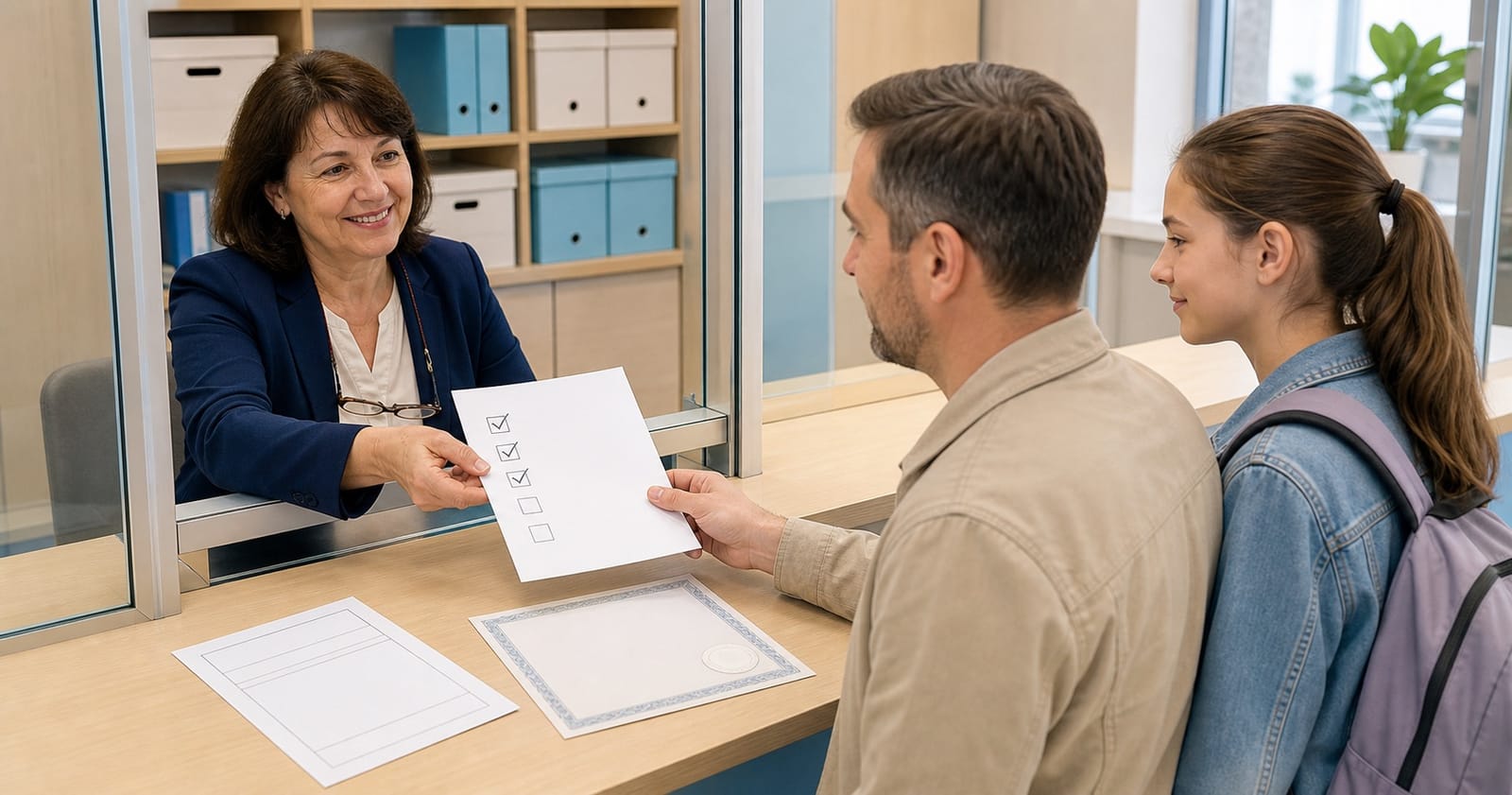
The exam costs somewhere between roughly 100 and 180 euros and takes a whole day. Before you register, two questions are worth asking: do I need it at all, and am I one of the people the law exempts? Both questions are about money and time, and the answer in the statute is clearer than it looks.
We are not an examination centre and not a law firm. What follows is a summary of publicly available rules, with the exact provision named each time so you can check it yourself.
First things first: the exam is attached to one permit only
The Slovak language exam at CEFR level A2 is a condition for being granted long-term residence — EU long-term resident status. It follows from § 52(7) and § 54(4) of Act No. 404/2011 Coll. on the residence of foreigners and has applied since 15 July 2025.
The Act attaches the exam to nothing else. Permanent residence (trvalý pobyt), temporary residence (prechodný pobyt) for work, business, study or family reunification, employment as such and study as such carry no language condition whatsoever. If you are applying for temporary residence for work, or for permanent residence, you do not need this exam and passing it will not improve your application.
We say this bluntly on purpose: several commercial pages advertise the exam as a requirement for permanent or temporary residence. It is not, and people pay for something nobody asked them for. We go through it in detail in our article on which permit the exam actually gates. Confirm with the foreigners police what document your particular application actually requires.
The statutory exemptions in § 52(7)
If you are applying for long-term residence, the foreigners police grant it without a passed language exam in the following cases.
1. The applicant was under 14 at the date of application
Children under fourteen do not sit the exam. What matters is the age on the date the application is filed, not on the date of the decision.
Now the other half of the same sentence: there is no upper age exemption. This surprises more readers than anything else on the page. A seventy-year-old applicant is not excused because of age — the Act contains no exemption for older people. If the reason is a permanent adverse state of health, there is a separate route described below, but age on its own is not it.
2. Temporary residence as a Slovak living abroad
Anyone holding temporary residence in the capacity of a Slovak living abroad (Slovák žijúci v zahraničí) does not sit the exam. What counts is that the residence in that capacity has actually been granted, not the underlying certificate on its own.
3. Lower secondary education at a Slovak-medium school
Anyone who obtained lower secondary education — completed the second stage of primary school — at a school teaching in Slovak does not sit the exam. This is the most generous of the exemptions, because it carries no time limit at all. If you finished Slovak-medium primary school fifteen or twenty years ago, it counts exactly as much as if you had finished it last year.
4. Two school years, or two academic years — with the five-year window
The exam is also waived for an applicant who was educated for at least two school years at a Slovak-medium primary or secondary school, or who studied for at least two academic years in a Slovak-language university programme — and not more than five years have passed since that education or study.
This is where mistakes happen. The five-year window governs this fourth limb only. It does not apply to completed lower secondary education in the previous point, which has no deadline whatsoever. So: two years of university study in Slovak that ended seven years ago no longer helps you; a Slovak-medium primary school completed seven years ago still does.
The health waiver is a possibility, not an entitlement
The Ministry of the Interior of the Slovak Republic may waive the requirement to submit proof of Slovak if the applicant cannot meet it because of a permanent adverse physical or mental health condition.
That word "may" carries the weight. This is not an automatic entitlement you claim on a form; it is a decision the Ministry takes on the individual case. Do not plan around it as if it were certain. If you think it may apply to you, ask the foreigners police in advance which medical documents they expect with the application.
Two groups the obligation never reaches
Citizens of the EU, the EEA and Switzerland, and their family members. Their stay is governed by free-movement rules. They do not apply for long-term residence for third-country nationals at all, so the obligation does not reach them — this is a different legal regime rather than an exemption from the exam.
People holding temporary protection (dočasné útočisko). While they hold that status they are not obliged to sit the exam. It is still worth thinking ahead: the route from temporary protection into a more settled residence regime leads precisely to long-term residence, where the language condition does apply. If you are considering that step a year or two from now, it makes sense to start preparing before the status changes.
What is not an exemption
- A Czech-language certificate. We found no provision in the Act recognising a Czech certificate as a substitute. We will not promise one, and you should not rely on it — check your specific document with the foreigners police in advance.
- A course-attendance confirmation. What is recognised is the certificate of a passed exam, not a confirmation that you attended a course.
- The citizenship exemptions. Citizenship is a separate procedure with a different condition — an interview under § 7(1)(j) of Act No. 40/1993 Coll. — and its own substitutes use a ten-year window. That ten-year window and the five-year one above have nothing to do with each other and must never be mixed up.
And if no exemption applies
Then you have a written and an oral part ahead of you, and a threshold of at least 70 % of the total points across both parts together (guidance of the Ministry of Education, Research, Development and Youth of the Slovak Republic of 27 October 2025, issued under § 54(4) of Act No. 404/2011 Coll.). You can work through free sample tests built on the published model test — start with the first pack — and it is worth preparing separately for the oral part, which almost nobody else describes.
Where to check
The wording of the exemptions is in Act No. 404/2011 Coll. on slov-lex.sk; a readable overview of long-term residence is published by the IOM Migration Information Centre; the exam rules are in the Ministry guidance. Whether an exemption covers your application is decided by the foreigners police, and only their answer is binding. More questions are answered in our FAQ.
We are not an examination centre and not a law firm, and we do not administer exams; this is not legal advice. Last verified 12 August 2026.